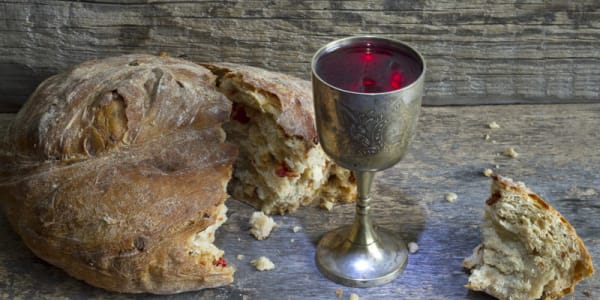
The day before He was crucified, Jesus commanded His disciples to continue to celebrate the Lord’s Supper, or Communion. (Matthew 26:26-30; Mark 14:22-25; Luke 22:14-20.)
Paul writes about this in 1 Corinthians 11:23-29: “For I received from the Lord that which I also delivered to you: that the Lord Jesus on the same night in which He was betrayed took bread; and when He had given thanks, He broke it and said, ‘Take, eat; this is My body which is broken for you; do this in remembrance of Me.’ In the same manner He also took the cup after supper, saying, ‘This cup is the new covenant in My blood. This do, as often as you drink it, in remembrance of Me.’ For as often as you eat this bread and drink this cup, you proclaim the Lord’s death till He comes.
“Therefore whoever eats this bread or drinks this cup of the Lord in an unworthy manner will be guilty of the body and blood of the Lord. But let a man examine himself, and so let him eat of the bread and drink of the cup. For he who eats and drinks in an unworthy manner eats and drinks judgment to himself, not discerning the Lord’s body.”
The Lord’s Supper: In memory of Jesus
The Lord’s Supper is a testimony. By taking part in it, I testify that Jesus’ body was broken for me and that He gave His blood for me. In that way I testify of the death of Christ. We are to do this in memory of Him. When I break the bread, I remember how His body was broken for me. When I drink of the cup, I remember that He gave His blood for my sake to forgive my sins. At the same time I testify that I have received this gift, or this grace. I do not take part in Communion to receive forgiveness for my sins, but because I have received the forgiveness for my sins.
Eating and drinking in an unworthy manner
God will not forgive me my sins if I do not forgive others. (Matthew 6:15.) “That is why you should examine yourself before eating the bread and drinking the cup.” 1 Corinthians 11:28 (NLT). If there is someone I cannot forgive, I cannot receive forgiveness. If I then drink of the cup, I testify against myself. I bring judgement over myself.
We have to walk in Godly fear while we are here on earth because we have been saved from our empty way of life by the precious blood of Christ. (1 Peter 1:17-19.) Every person must examine himself - if he hates this empty way of life; then he may eat the bread and drink of the cup. I eat and drink in an unworthy manner if there is a sin in my life that I love and do not want to let go. He has given His blood to save me. If I want to hold on to my sin, I am judged, and I sin against the body and the blood of the Lord.
Communion: One body
“When we bless the cup at the Lord’s Table, aren’t we sharing in the blood of Christ? And when we break the bread, aren’t we sharing in the body of Christ? And though we are many, we all eat from one loaf of bread, showing that we are one body.” 1 Corinthians 10:16-17 (NLT).
All those who break the bread testify that they do not serve themselves, but each other. When I break the bread, I testify that I do not live for myself, but for the others, and that I am willing to accept all the help for salvation they can give me because we all eat of the same bread. Let each one examine himself, and then break the bread.
Because Jesus gave His life for us, we should also give our lives for each other. (1 John 3:16.) When I eat and drink, I testify that I would give my life for those who in truth eat of the same bread, because we testify about the death of the Lord. When I testify about His death, I also testify that I died with Him so that I will no longer live for myself, but for Him who died for me and rose again. (2 Corinthians 5:15.)
Each part, or member, of a physical body shares nourishment and strength with the rest of the body; in this way we should also give the other members of Christ’s body of all the love, wisdom, strength, grace, mercy, patience, and faithfulness that we receive from Christ. If we are not willing to love, we are also not worthy to receive love. (1 John 4:11.) If we are not willing to be merciful, forgiving, easy to get along with, helpful, or understanding, then we are also not worthy to receive these blessings.
Let each one examine himself before he comes to the Lord’s Supper, and so eat of the bread and drink of the cup.